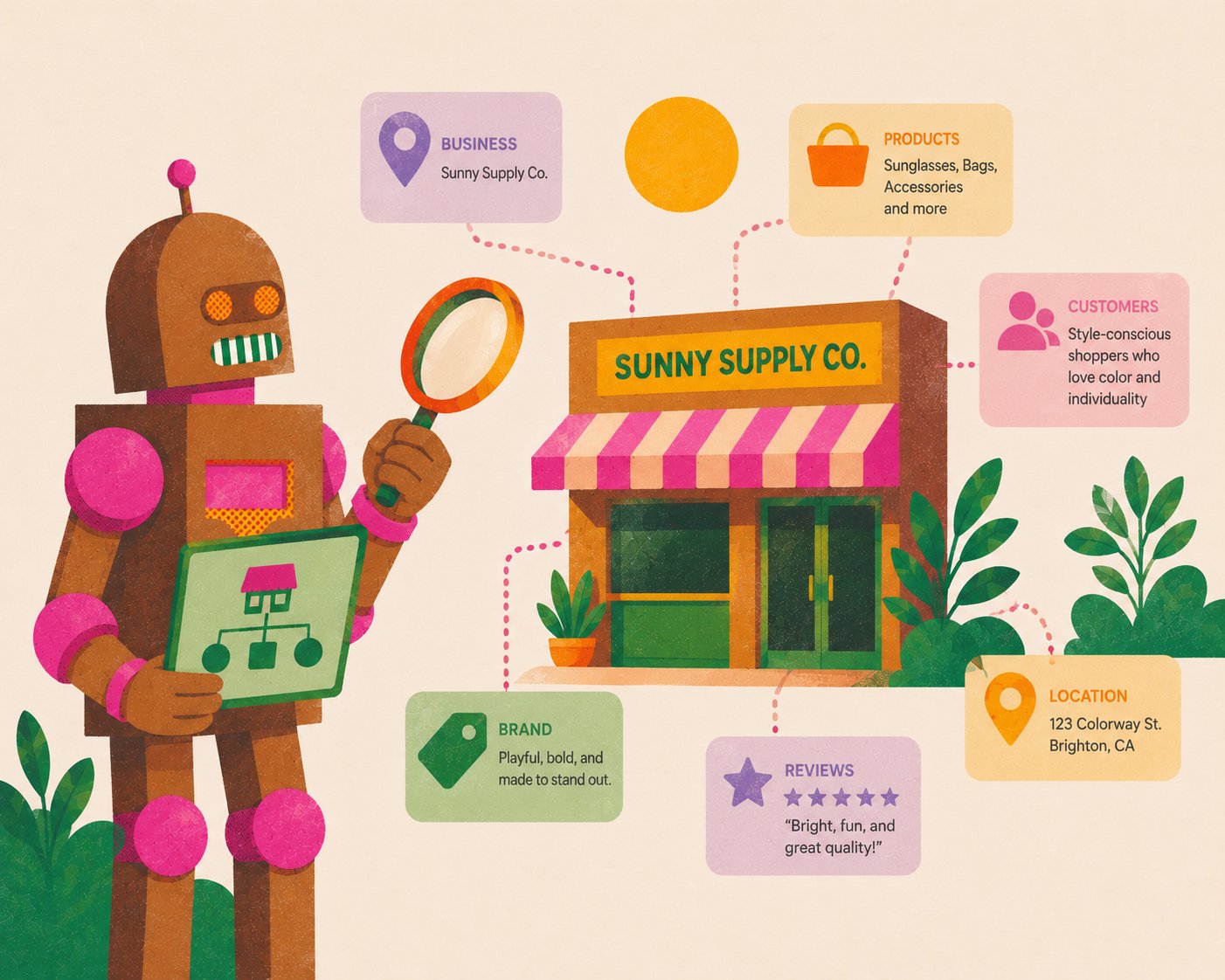
To be found by AI, you need to be unmistakably clear about who you are. Fast.
SEO was largely about keywords. AI visibility is about entities. The interconnected facts, relationships, and signals that help machines understand your business.
Keywords describe text. Entities describe reality.
Large language models like ChatGPT, Claude and Gemini no longer just scan for words. They identify real-world things. People, companies, products, services, locations, ideas. Then they connect them together to work out what your business is, what it does, who it serves, and whether it can be trusted.
If another business is clearer, more consistent, and supported by a richer network of connected entities, they are far more likely to win the citation, the recommendation, the mention. Those entity relationships increasingly decide who gets surfaced. And who gets ignored.
SEO tried to understand pages. AI tries to understand the world.
I'm Michelle Legge, founder of Everwilde One, a content-centric AI visibility agency based in Cape Town. Because I think AI visibility is mostly a content problem, I wanted to unpack AI entity 101 as the first guide in this series.
What is an AI entity?
An AI entity is a real-world thing that AI systems can identify, categorise and connect to other things. People, businesses, products, services, places, events, ideas.
Entities are not keywords. They are the things keywords point to.
AI entity semantics example: "Apple"
When someone types "Apple" into a search box, the word itself is just a keyword.
The entities are:
- Apple (the technology company)
- Apple (the fruit)
- Fiona Apple (the musician)
The job of the AI is to work out which one you meant.
That process is called entity disambiguation.
The AI uses surrounding context and entity relationships to resolve ambiguity.
For example:
Apple + iPhone + MacBook + Tim Cook clearly points to the technology company.
While Apple + pie + cinnamon + fruit salad clearly points to the fruit.
And Apple + Criminal + 1996 + Grammy points to the musician.
This is why semantic search is so much more powerful than traditional keyword matching. LLMs are not just reading words. They are working out meaning.
AI entity examples
The fastest way to understand entities is to see them.
Brand entity example
Take Canva.
Canva is an entity.
But AI also connects Canva to:
- graphic design software
- presentation templates
- marketing teams
- social media graphics
- collaboration tools
- browser-based editing
Together, those relationships help LLMs understand:
- what Canva is
- who it serves
- what problems it solves
- and when it should be recommended
Local entity example
Take a London plumber.
AI may connect that business to:
- London
- emergency plumbing
- burst pipes
- residential homes
- Google reviews
- geyser repairs
Together, those relationships help AI search engines understand:
- what the business does
- where it operates
- who it serves
- and whether it is trustworthy
Third-party entity example
Third-party mentions are powerful entity signals because they help corroborate authority and trust.
Take this single phrase:
"Forbes Top AI Visibility Agency 2026"
That one mention creates relationships between multiple entities at once:
- Forbes as the trusted publication
- AI visibility as the category
- agency as the business type
- 2026 as the time anchor
- rankings as the form of recognition
The more trusted external sources consistently associate your business with a topic or category, the stronger your entity footprint becomes.
Strong vs weak AI entities
This is where entity clarity becomes practical.
Strong AI entity example
"A Cape Town content-centric AI visibility agency helping B2B brands get cited by ChatGPT, Perplexity and Google AI."
That single sentence contains:
- a location entity
- service entities
- audience entities
- outcome entities
- an industry entity
An AI system has a lot to work with.
It knows:
- what the business is
- where it operates
- who it serves
- and what outcomes it delivers
Weak AI entity example
Now compare that to:
"A dynamic solutions provider helping businesses unlock growth through innovative, next-generation digital experiences."
That sentence is grammatically correct and almost completely entity-empty.
LLMs struggle with vague positioning because there are very few strong entities to connect together.
It lacks:
- a clear category
- an identifiable service
- an audience
- a location
- a use case
- a differentiator
The polished, generic, interchangeable description is one of the most common entity failures in B2B marketing.
LLMs will usually pass over it and surface a clearer business instead.
How AI finds entities
In NLP (natural language processing), the branch of AI focused on understanding human language, LLMs use entity extraction to turn unstructured language into structured information machines can understand.
Classically, this involved three tasks:
Named Entity Recognition (NER)
Identifying entities inside text.
Example:
- Apple
- Cape Town
- Elon Musk
Entity linking
Connecting each mention to a specific real-world entity.
For example:
- Apple → technology company
- not → fruit
Entity disambiguation
Resolving conflicts between similar entities using context.
These ideas still underpin how search and AI retrieval systems work today.
What changed is that modern LLMs now perform much of this natively.
The vector layer
LLMs don't store entities like rows in a spreadsheet.
They store them as positions in a high-dimensional space where related entities sit close together.
For example:
- Canva sits near Figma and Adobe Express
- Cape Town sits near Johannesburg and Western Cape
This is why AI can answer:
"What's an alternative to Canva for small businesses?"
Without anyone needing to hardcode that exact comparison.
The knowledge graph layer
Alongside vector relationships, LLMs also draw on structured knowledge graphs.
This is where Google's famous phrase came from:
"Things, not strings."
Knowledge graphs link entities through structured relationships.
For example:
- Apple → founded by → Steve Jobs
- Canva → category → graphic design software
- Cape Town → located in → South Africa
These relationships help ground LLMs in factual, machine-readable information.
AI entities understand synonyms and variations
LLMs understand that:
- math
- maths
- mathematics
May all point to the same underlying entity.
The same applies to:
- brand entities
- products
- abbreviations
- services
- industry language
This is why semantic consistency matters more than exact keyword repetition.
Repeating "AI visibility agency" fifty times on a page means very little if the rest of the web has no corroborating entity signals around your business.
AI is not simply counting words. It is connecting things.
AI entity systems and ecosystems
Entities rarely exist alone.
Generative AI systems build networks of relationships between:
- brands
- people
- products
- industries
- topics
- reviews
- publications
- competitors
- technologies
- audiences
This interconnected layer is often called:
- a knowledge graph
- an entity graph
- a semantic network
- an entity ecosystem
For example, a design SaaS brand may connect to:
- marketing teams
- educators
- startups
- Adobe
- Figma
- templates
- presentations
- remote collaboration
- browser-based design tools
The richer and more connected these relationships become across the web, the stronger the entity becomes inside LLMs.
AI entity industry terms you'll see
Depending on who's talking, the same set of ideas gets called a lot of different things.
You'll commonly hear:
- Entity SEO
- LLMO (LLM optimisation)
- GEO (generative engine optimisation)
- AEO (answer engine optimisation)
- Semantic search
- Knowledge graphs
- Grounding
- Retrieval-augmented generation (RAG)
- Entity extraction
- Entity linking
- Entity disambiguation
- Topical authority
- Structured data
- "Things, not strings"
Most of these concepts point to the same underlying truth.
AI understands the world as a graph of connected things, not as a list of keywords.
This piece is critical to LLMO. If you want to be cited by LLMs, entity clarity is where the work starts. Schema, technical fixes and prompt engineering all sit downstream of the entity claims your business makes.
Why third-party entities matter more than your own
LLMs usually weight what other people say about you more heavily than what you say about yourself.
Your About page is one voice. The web is thousands. AI listens to the thousands.
A single mention in a trusted publication creates relationships between:
- your business
- the category
- the publication's credibility
- the time period
- the audience
- the topic itself
Those relationships compound over time.
Five trusted mentions from external sources often do more for AI visibility than fifty pages on your own website.
What this means for your business
Three things, in order of priority.
Pick your entity claims and hold them. Category, audience, capability, location. Same claims across every surface. Website, LinkedIn, PR, podcasts, directories, author bios.
Build corroboration. The web has to say the same things about you that you say about yourself. Press, citations, guest content, third-party mentions. AI trusts what other people say about you more than what you say.
Make it machine-readable. Schema markup, structured data, Wikidata entries, clean About pages with the entity claims in plain prose. The robots will read it. The humans benefit too.
What's next
Now you know what entities are, what they look like, and why they decide who gets cited.
The next post in this series is the practical one: How to use entity strategy for AI search visibility. The moves. The stuff you can do this week.

Michelle Legge
Founder of Everwilde One, a content-centric AI visibility agency based in Cape Town. Two decades in content strategy, SEO and copywriting. Past brands include TEDx and Qantas.
Not showing up on ChatGPT?
Probably because how you describe yourself is inconsistent or incomplete. Everwilde One's AI Search Entity Builder is a free tool that helps you fix that. 3 minutes to map out what your business looks like from an entity point of view. No catch.
Or, if you'd rather talk it through, send me a message on WhatsApp. I'll tell you what I'd do.
Help me define my AI search entity