For 20 years I have worked in search, content and digital marketing. Most people know me through that, and more recently as the founder of Everwilde One, where we help businesses get found across search engines, AI systems and answer engines.
What fewer people know is that I have spent the last 9 years building a consumer brand too. In 2017 I founded Superlatte, a wellness brand that makes and sells superfood latte blends across South Africa. It started as a market stall at Cape Town's Oranjezicht City Farm Market and grew into a brand supplying both retail customers and cafés.
That second business recently taught me something about AI search that no client project ever has.
A customer sent me a screenshot with a simple question.
I thought your matcha lasted 24 months. Why does Google say it only lasts 30 days?
It stopped me cold. I know our products. I know how we make them. I know our shelf life. And I knew for certain we had never published anything saying our Organic Ceremonial Matcha lasts only 30 days.
My first thought was something worse. A competitor publishing misleading information. A reseller copying incorrect product details. An old page surfacing somewhere it shouldn't. Then I looked at the screenshot properly.
The source was not a competitor. It was a Google AI Overview.
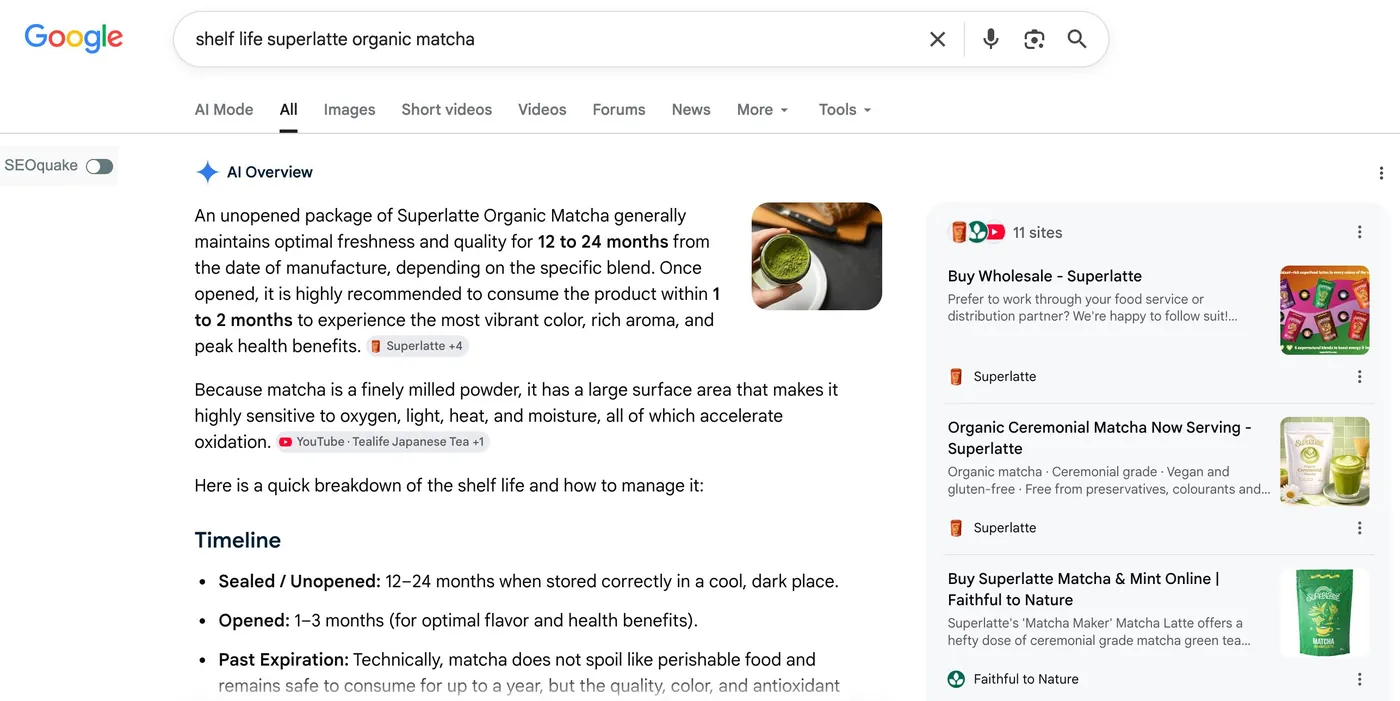
That solved the mystery of how the customer reached the wrong conclusion. The more interesting question was the one I couldn't answer. How many other people had seen the same thing and moved on without asking?
What really happened
Once I dug into the query, it was clear Google was blending generic advice about how long ceremonial matcha stays fresh with information about a specific Superlatte product.
That distinction matters more than it looks. The customer wasn't asking how long ceremonial matcha generally keeps. They were asking how long Superlatte Organic Ceremonial Matcha lasts. Different questions, very different answers.
Our product carries a 24 month shelf life from the date of manufacture. That date is printed on every pack. It reflects our packaging specs, our quality controls, how we handle ingredients, and years of making the stuff. But somewhere between the customer's question and Google's answer, the line between category information and product information broke down. The result read as authoritative and was wrong in context.
Why this matters more than it used to
A lot of businesses still treat AI Overviews as a curiosity. I think that's a mistake.
Here is the part that should worry any brand owner. When Pew Research tracked how people behave around AI Overviews in 2025, they found users clicked a link inside the overview just 1% of the time. Almost nobody scrolls down to check the source. They read the summary, they take it as the answer, and they move on. Surveys also show only a small minority of people say they fully trust these summaries, yet their behaviour tells a different story. We treat the machine's answer as gospel without realising we are doing it. I see it in my own life. This matcha screenshot was not even the first AI Overview a customer or friend had forwarded me that week about something that mattered. It is becoming a pattern. We dig into the numbers in our roundup of AI search statistics.
AI systems increasingly sit between a customer and a brand. For a lot of searches now, the customer forms an opinion before they ever reach your website. Which means wrong information doesn't have to stop a sale outright. It only has to create enough doubt.
If someone believes your product expires in 30 days, they might not buy it. If they believe your service isn't available in their region, they might never get in touch. If they believe your pricing is far higher than it is, they keep scrolling. The customer doesn't need to be annoyed. They just need to leave.
This is a new kind of visibility problem
Old-school SEO was mostly about discovery. Could people find your website, could you rank for the right terms, could you earn the click. AI search adds a harder question on top of that one. Can a machine accurately understand your business? This is really a question of whether you read as a clear entity the system can recognise. If you don't, it will happily explain your products, pricing, availability or policies to a customer, incorrectly and with total confidence.
That is a different problem to solve, and most businesses never even see it happening. Traditional SEO gives you feedback: rankings, impressions, click-through rates, traffic, conversions. AI answers often give you none of that. Customers rarely email to report an inaccuracy. They read it, they believe it, they move on.
We got lucky. One customer took the time to ask. Without that message, I might still not know.
Why you should search your own brand obsessively
The easiest AI visibility exercise any business can do is search for itself. Not the brand name. Not the homepage. The actual questions your customers ask. Things like brand + ingredients, brand + pricing, brand + shelf life, brand + shipping, brand + safety, brand + alternatives.
Those are exactly the searches that tend to trigger an AI summary. If you aren't checking them, you've handed your brand narrative to a system you aren't watching.
What we did about it
We handled it the way we'd handle it for any Everwilde One client. First we investigated the query and looked for where the confusion was coming from. Then we checked whether there was a clear source of truth for a machine to retrieve.
There wasn't, not really. We had product pages. We had information scattered across the site. We had never imagined a customer would specifically ask whether our matcha had a 30 day shelf life, so we'd never answered it directly.
So we built a dedicated resource. One page that clearly answers what the shelf life of Superlatte Organic Ceremonial Matcha is, how to store it, whether opening the pouch changes anything, why it carries a 24 month shelf life, and how we manage freshness. Then we expanded the supporting content around quality control, packaging, traceability and how we handle ingredients. The aim was plain: make the correct answer easy for both people and machines to find. This is the everyday content work behind AI visibility, the unglamorous part that moves the needle.
What I expect to happen next
One of the biggest misconceptions about AI optimisation is that changes land immediately. They don't. Google has to discover the new content, process it, understand it, and decide whether it should feed future answers. There's no guaranteed timeline. Days, weeks, maybe longer.
My expectation is that a stronger, more explicit source of truth raises the odds of accurate retrieval over time. I'll keep watching the query and report back on what happens.
The AI visibility audit every business should run
If you take one thing from this, take this. Set aside 30 minutes this week and work through your own brand the way a customer would.
Start with how the machine understands the business itself. Search what is [brand], who owns [brand], where is [brand] based, is [brand] legitimate, and read the answers carefully.
Then test how it understands your products. Search [product] ingredients, [product] pricing, [product] shelf life, [product] safety, [product] reviews, and look for anything inaccurate, missing or confusing.
Do the same for your services. Search does [brand] offer [service], where does [brand] operate, who is [brand] for, how does [brand] work. Then check how the machine positions you against everyone else, with [brand] vs competitor and best alternative to [brand]. Those comparison queries are often the most revealing.
Finally, for every important question, ask yourself whether you have a dedicated page that answers it, whether that answer is easy to find, whether it is specific to your business, and whether a machine could realistically misread it. Where the answer is no, that's your work.
The bigger lesson
The interesting part of this isn't that Google got something wrong. The internet has always been full of inaccuracies. The real story is that AI systems now act as interpreters between businesses and customers. When they misunderstand your business, customers form opinions based on things you never said.
Visibility used to be about rankings. It's becoming about understanding, the core idea behind Search Everywhere Optimization. And in a world where machines do more and more of the explaining, being understood correctly might be the most valuable kind of visibility a business can earn.
Want to know what the machines think you are?
If an AI system can misread a shelf life, it can misread who you serve, what you sell and why you matter. Everwilde One's AI Search Entity Builder is a free tool that maps how your business reads as an entity, so you can spot the gaps before a customer does. 3 minutes, no catch.
Or, if you'd rather talk it through, send me a message on WhatsApp. I'll tell you what I'd do.
Help me define my AI search entity
Michelle Legge
20 years across brand storytelling, SEO, content strategy and now AI visibility. Founder of the superfood latte brand Superlatte. EMEA-focused, globally experienced, Cape Town based.